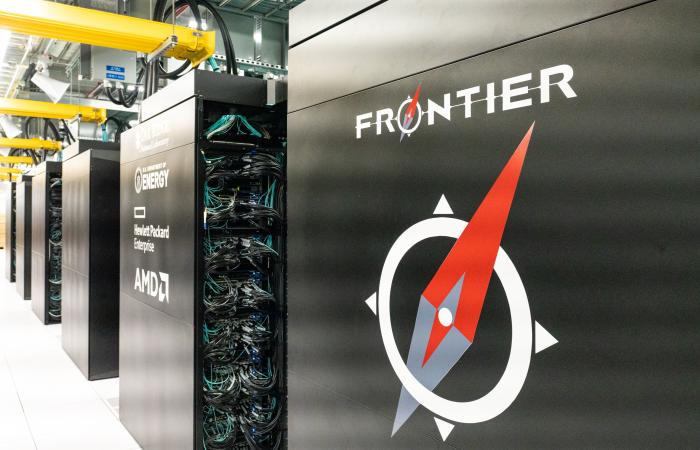

Frontier’s overall performance of 1.1 exaflops translates to more than one quintillion floating point operations per second, or flops, as measured by the High-Performance Linpack Benchmark test. Each flop represents a possible calculation, such as addition, subtraction, multiplication or division.
Frontier’s early performance on the Linpack benchmark amounts to more than seven times that of Summit at 148.6 petaflops. Summit continues as an impressive, highly ranked workhorse machine for open science, listed at number four on the TOP500.
Frontier’s mixed-precision computing performance clocked in at roughly 6.88 exaflops, or more than 6.8 quintillion flops per second, as measured by the High-Performance Linpack-Accelerator Introspection, or HPL-AI, test. The HPL-AI test measures calculation speeds in the computing formats typically used by the machine-learning methods that drive advances in artificial intelligence.
Detailed simulations relied on by traditional HPC users to model such phenomena as cancer cells, supernovas, the coronavirus or the atomic structure of elements require 64-bit precision, a computationally demanding form of computing accuracy. Machine-learning algorithms typically require much less precision — sometimes as little as 32-, 24- or 16-bit accuracy — and can take advantage of special hardware in the graphic processing units, or GPUs, relied on by machines like Frontier to reach even faster speeds.
ORNL and its partners continue to execute the bring-up of Frontier on schedule. Next steps include continued testing and validation of the system, which remains on track for final acceptance and early science access later in 2022 and open for full science at the beginning of 2023.